Great, let's delve into ways to share that valuable information out effectively.
Disseminating information in the field can occur in many forms and fashions. Start with the consideration of who your audience is or should be. Who most needs this information to make informed decisions. Then consider how the information should be displayed. Here are some examples of information that may result from data collection or evaluation efforts and ways that information can be shared in the field in a useful way.
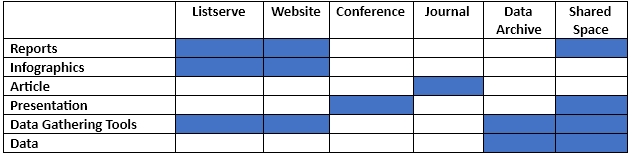
Reports. Reports are often the lowest common denominator. Typically, any monitoring, data collection, or evaluation efforts will result in some type of report back to the funding agency. Most of these reports are easy to adapt for public dissemination. If there are confidentiality concerns, then the report should be cleaned so that all identifying information (including judge or site name) is erased. Then the report can be shared. Reports can be shared on websites and easily linked to other sites. Broader dissemination could include sharing the link to the report on a list serve for those of interest (such as the Court Improvement Program list serve).
Infographics. Infographics are short visual representations of findings. They offer less detail than a full report and are meant to highlight specific findings. Infographics can be shared in multiple ways, including websites and via list serves.
Articles. The information can also be written into an academic style article for publication in a journal. This is most common when a university partnership exists with the program as academics use journals are a primary outlet for information sharing. There are several types of publication outlets that may not require the same rigor as a peer-reviewed journal and would be very useful to share information. Consider different types of outlets that meet your audience needs. Some examples might be:
- The American Bar Association's Child Law Practice Today
- Children and Youth Services Review
- The National Council of Juvenile and Family Court Judges’ Juvenile and Family Court Journal
- Family Court Review
Presentations. Another way to share information is to talk about the project, what you learned, what you found (positive, negative or nothing) through a presentation. Presentations could be on a virtual platform, like a webinar hosted by a technical assistance provider (like the Capacity Building Center for Courts) or could be in person through local, state, or national conferences in your field of expertise. In the child welfare court system, the following organizations have annual or semi-annual conferences that may be of interest.
- American Bar Association
- National Center for State Courts
- National Council of Juvenile and Family Court Judges
- National Association of Counsel for Children
Tools. You can also disseminate information by sharing the tool(s) you used to do your hearing quality work. Many states are doing work and would love to be able to reference another site’s tool to see where there are commonalities and differences. Every tool shared provides an opportunity for someone to learn someone else’s perspective and how they have approached gathering data. This can be an invaluable learning opportunity. Tools do not include confidential information so can be shared broadly, via website, through email on list serves, or through a hosted information sharing platform.
Data. A final way to disseminate information is to consider sharing your data, either raw data or summary data. Data can always be cleaned and modified so that identifying information is not included and it would still be useful. In particular, learning what a dataset might look like or how someone else has chosen to display their summary data may help contribute to learning. Further, from a broader perspective, if everyone shared their hearing quality data, then we could identify national trends that could help move the field forward in a meaningful way.
This table summarizes that types of information that could be shared and the common means of sharing.